The Echoes of Eternity: Unraveling the Secrets of the Cosmic Microwave Background
Picture this. You're a kid. You've dragged an old tube TV out of someone's garage, and you flip it to a dead channel. That grainy, hissing snow filling the screen? Turns out, roughly 1% of that static isn't broken equipment or bad signal. It's something far stranger. Far older. It's leftover heat from the birth of the universe — still drifting, still whispering, after 13.8 billion years. That signal has a name: the Cosmic Microwave Background (CMB). And quietly, without much fanfare, it may be the most important thing ever discovered in the history of astronomy.
This isn't some abstract equation scrawled on a chalkboard. The CMB is a real photograph — the universe's actual baby picture. Blurry, ancient, stretched beyond recognition. But read it right, and it tells you everything: what the cosmos is built from, how long it's been alive, and how it will one day go dark.
A Nobel Discovery (Blamed on Pigeon Poop)
Here's the part nobody tells you in textbooks. The CMB wasn't found by someone hunched over calculations at 2 a.m. It was stumbled upon, completely by accident, by two astronomers who spent weeks convinced their antenna was just... dirty.
It's 1964. Arno Penzias and Robert Wilson are at Bell Labs in New Jersey, fussing with a massive horn-shaped antenna. They want clean data. Instead, no matter where they swing the dish — north, south, straight up — there's this low, stubborn hum. Everywhere. Always. They check the equipment. They hunt for interference from the city. Then, in what has to be the most gloriously unglamorous moment in scientific history, they physically climb inside the horn with brooms. There's a pigeon nest in there. Droppings. They scrub it down. They shoo the birds. And the hum? Still there. Completely unbothered.
It wasn't the pigeons. It was the Big Bang — still echoing, all these billions of years later. Penzias and Wilson had stumbled onto the smoking gun of creation itself. They took home the Nobel Prize. The pigeons got nothing.
The First Light in the Universe
Now — and this part matters — the CMB is not a photo of the Big Bang itself. That moment? It was chaos. Pure, blinding, incomprehensible chaos. The newborn universe was so hot and so dense that light couldn't even move. Every photon that tried to travel just crashed straight into a free electron. For 380,000 years, the whole cosmos was basically an opaque, glowing wall of plasma soup.
Then something shifted. The universe kept expanding, kept cooling. Right around 3,000 Kelvin — roughly 5,000 degrees Fahrenheit — something remarkable happened. Protons finally slowed down enough to grab electrons. The first hydrogen atoms formed. And just like that, the fog lifted. Light broke free and streamed outward in every direction for the very first time.
That flash of ancient orange-white light has been traveling ever since. But the universe hasn't been sitting still — it's been expanding, stretching those light waves like taffy, cooling them from thousands of degrees all the way down to 2.7 Kelvin, just a hair above absolute zero. The light shifted — redshifted — from visible glow into invisible microwaves. That's what Penzias and Wilson heard. That's the CMB.
Deciphering the Cosmic Barcode
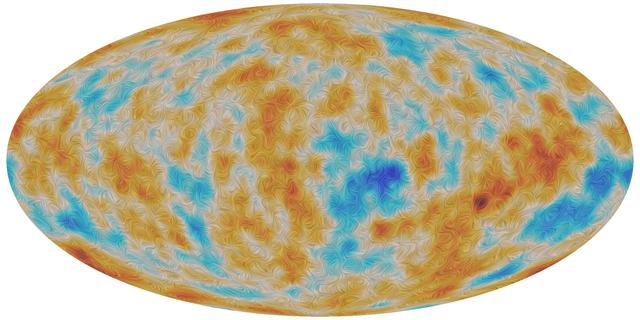
Look at a CMB map — that swirling oval of reds and blues — and you're staring at temperature differences so tiny they're almost insulting. Fractions of a degree. That's it. But don't let the subtlety fool you. Those faint hot and cold patches are the reason you exist.
The slightly denser, cooler regions? Gravity loved them. Over billions of years, matter clumped, collapsed, snowballed — turning into the first stars, then galaxies, then the enormous cosmic web we live inside today. By mapping those ancient ripples with obsessive precision, cosmologists have essentially cracked the universe's recipe:
- Normal Matter (stars, planets, you, me): ~5%
- Dark Matter (the invisible scaffolding holding it all together): ~27%
- Dark Energy (the force quietly tearing everything apart): ~68%
What Comes Next in the Dark?
We're not done. Not even close. Experiments like the Simons Observatory and the future CMB-S4 project are pushing detectors to the very edge of what physics allows. Scientists are chasing something elusive — a faint, twisted signature in the CMB light called "B-mode polarization." If they find it, it changes everything.
Did You Know? That twisted pattern, if detected, would be the fingerprint of Primordial Gravitational Waves — actual ripples in spacetime shaken loose in the first trillionth of a trillionth of a second after the Big Bang. Not metaphorical ripples. Real ones. Pressed into the fabric of existence before a single atom existed.
There's something that hits different when you sit with all of this. Every time a microwave telescope opens its eye to the sky, it's not looking at empty space. It's listening. The universe has been telling its own origin story, over and over, across 13.8 billion years of cold silence. We just finally built ears good enough to hear it.