Decoding Alien Skies: How We Read Exoplanet Atmospheres
For a long time, just catching a glimpse — a faint, fleeting shadow — of a planet orbiting some distant star was enough to make headlines. Enough to feel like magic. But that bar has moved. Dramatically. We're not just spotting exoplanets now. We're reading their skies. Sniffing their air. Mapping what's floating in atmospheres hundreds of trillions of miles away, and asking whether any of it looks familiar — whether any of it looks like us.
Because the tools we build here at Moonlight Moments pull live data straight from NASA's open APIs, we get a front-row seat to this science as it unfolds in real time. And right now? It's moving fast. Here's how astronomers actually pull off something that sounds, frankly, impossible — reading the invisible air of other worlds.
How Do We See Invisible Air? The Power of Transit Spectroscopy
You can't just aim a telescope at an exoplanet and photograph its clouds. The star it orbits is blinding — everything else just drowns in that glare. So astronomers got creative. Brilliantly, almost sneakily creative. They use a technique called transit spectroscopy, and once you understand it, it's hard not to feel a little awestruck.
When a planet drifts across the face of its star — a transit — a thin sliver of that starlight passes through the planet's atmosphere on its way to us. Different gases intercept different wavelengths. Hydrogen absorbs here. Methane absorbs there. Carbon dioxide takes its slice. What arrives at our telescopes is starlight with gaps in it — specific colors missing, specific fingerprints left behind. Scientists read those gaps like a barcode, and the barcode tells them exactly what's floating in that alien sky.
The James Webb Era: Ripping Up the Textbooks
Hubble did something remarkable — it proved the technique worked, showed us it was possible to taste the chemistry of a world we'd never visit. But the James Webb Space Telescope arrived and changed the scale of the whole endeavor. JWST sees in infrared, deep into wavelengths that older telescopes were blind to, and it can pick out complex molecules with a clarity that still feels slightly unreal.
- WASP-39b: JWST made history here — the first time anyone had ever pulled a clear, unambiguous detection of carbon dioxide from an exoplanet's atmosphere. A line crossed that can't be uncrossed.
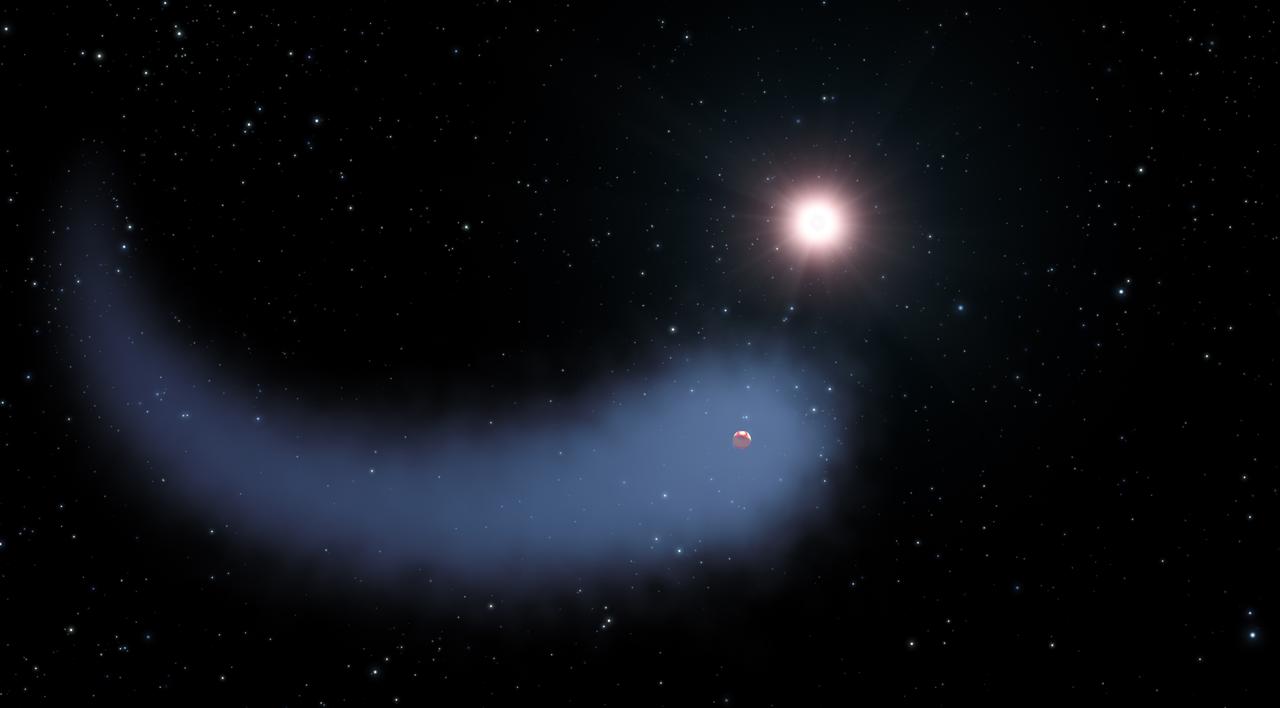
- Atmospheric Stripping: On the other end of the spectrum, JWST has also captured something brutal — planets orbiting too close to volatile red dwarf stars, their atmospheres being steadily torn away and scattered into space by relentless stellar winds. The universe doesn't always nurture. Sometimes it just erases.
The Ultimate Prize: Hunting for the Fingerprints of Life
Here's where it stops being just science and starts feeling like something else. Something almost philosophical. The real goal isn't cataloguing gases — it's finding a biosignature. A chemical signal so strange, so chemically unstable, that the only plausible explanation is life.
Think about it this way. Methane and oxygen don't like each other. They react. They destroy each other. If you find both present in an atmosphere at the same time, in meaningful quantities, something has to be continuously making them — replenishing both, fighting the chemistry. On Earth, that something is life. Organisms pumping out gases just by existing, just by breathing and eating and decomposing. Find that same impossible balance on a distant world, and the question changes entirely.
Did You Know? JWST detected carbon-bearing molecules — methane, carbon dioxide — in the atmosphere of K2-18b, a potential "Hycean" world sitting 120 light-years away, possibly covered in a vast ocean beneath a hydrogen-rich sky. And buried in that data: possible traces of dimethyl sulfide, a molecule that on Earth is produced almost exclusively by living marine organisms. Almost exclusively. That "almost" is doing a lot of work right now.
What Comes Next in the Dark
We're living in what future textbooks will probably call a golden age, though it rarely feels that neat from inside it. The Extremely Large Telescope (ELT), being carved out of Chile's Atacama Desert right now, will carry a primary mirror nearly 40 meters wide. When it opens its eye, it won't just detect atmospheres indirectly — it will directly image Earth-sized worlds and study their chemistry at a resolution JWST can't touch.
Every transit observed, every barcode decoded, chips away at the dark a little more. The question has already shifted from "are there other planets?" — we know that answer, there are billions — to something harder, quieter, and infinitely more loaded. We're not there yet. But we're closer than we've ever been.