Gravitational Waves Explained: How LIGO Hears the Universe
Some of the most violent events in the universe do not arrive as a flash of visible light. When two black holes spiral together, or two neutron stars collide, they send moving distortions through spacetime itself. These distortions are called gravitational waves. By measuring them, astronomers can study objects that may be dark, distant or hidden behind clouds of matter.
Ground-based observatories such as LIGO do not photograph a wave crossing the sky. They measure an almost impossibly small change in distance between mirrors, using laser light as a ruler. The signal rises and falls in a characteristic pattern, or chirp, that encodes the masses, motion and distance of the source. This is a new way to observe the cosmos alongside the light collected by telescopes. NASA's LISA mission overview describes gravitational waves as a complementary kind of information: they reveal motion and gravity directly, even when light cannot escape or reach us clearly.
What is a gravitational wave?
General relativity describes gravity as the geometry of spacetime. Massive objects change that geometry, and accelerating masses can send a ripple outward. The ripple stretches space in one direction while compressing it in the perpendicular direction, then reverses as it passes. The effect is not a wave moving through air or water. It is a change in the distances that define the space between objects.
Gravitational waves travel at the speed of light and interact very weakly with matter. That makes them difficult to detect, but it also lets them cross the universe with little absorption or scattering. Light from a collision can be blocked, delayed or reshaped by gas and dust. A gravitational wave carries a different record of the same event, one tied to the changing motion of the source.
Think of a gravitational wave as a change in the measuring grid itself. LIGO watches for the grid to stretch and squeeze in a pattern that no ordinary vibration can explain.
Which cosmic events make gravitational waves?
Black-hole mergers
Two black holes can orbit each other for millions or billions of years while slowly losing orbital energy. As the orbit shrinks, the pair moves faster and the gravitational-wave frequency increases. In the final fraction of a second, the black holes merge and settle into a single spinning black hole. The rising signal from this process is one of LIGO's clearest signatures. It also lets researchers test whether the remnant behaves as general relativity predicts, connecting this article to our guide to black-hole physics and Hawking radiation.
Neutron-star collisions
Neutron stars are compact remnants made mostly of ultra-dense matter. When a binary pair merges, the gravitational signal can be accompanied by a burst of gamma rays, a kilonova and a long-lived afterglow. The 2017 event GW170817 was the first gravitational-wave source observed with both gravitational and electromagnetic signals. That combination allowed astronomers to compare the timing, chemistry and geometry of the same cosmic collision.
Long signals and a background hum
Not every source produces a short chirp. A spinning neutron star with a small asymmetry could emit a nearly continuous wave. Many unresolved sources may also overlap into a background, much like separate instruments blending into a low hum. Different observatories are sensitive to different frequencies, so a complete gravitational-wave astronomy will need ground-based detectors, pulsar timing and space-based instruments.
How LIGO measures a ripple
LIGO uses two enormous L-shaped interferometers, one in Hanford, Washington, and one in Livingston, Louisiana. Each detector sends a laser beam to a beam splitter, divides it down two perpendicular arms, reflects the light from suspended mirrors, and recombines the beams. When the arms have the same effective length, the light mostly cancels at the photodetector. A passing gravitational wave changes the two arm lengths in opposite ways, shifting the interference pattern.
The arms are four kilometers long, but the wave-induced change is vastly smaller than anything a person could feel. LIGO's mirrors hang as carefully isolated test masses. The observatory also monitors earthquakes, traffic, wind, power systems and many other disturbances. A candidate signal must have the right shape and appear consistently at both separated detectors with the appropriate time delay. Comparing the sites helps the collaboration reject local noise.

The detectors do not simply wait for a loud bang. Analysis software compares the measured data with large libraries of predicted waveforms. The match helps estimate the source's mass, distance, orientation and sky position. When several detectors observe the same event, the arrival-time differences narrow the region of sky that telescopes should search.
What a gravitational-wave chirp reveals
A chirp contains a timeline of the orbit. Early in the signal, the objects are far apart and orbit more slowly. Later, the frequency and amplitude rise as the system loses energy. The rate of that rise is related to a combination of the objects' masses called the chirp mass. The final shape of the signal adds information about spins, orbital orientation and the remnant after merger.
Distance can be estimated from the strength and evolution of the waveform, making some gravitational-wave events useful as standard sirens. Unlike a standard candle, a siren does not need a calibrated luminosity. If an electromagnetic telescope identifies the host galaxy, the event can also help measure the expansion of the universe. That gives gravitational-wave astronomy a direct connection to the questions explored in our dark-energy guide.
Why the first detections changed astronomy
The first direct detection, announced in 2016 from a signal recorded in September 2015, came from two merging black holes. It confirmed a prediction of general relativity and opened a new observing channel. Before then, black-hole mergers were expected from theory and indirect evidence, but no instrument had measured the spacetime signal of the final collision.
GW170817 made the field even more powerful. Gravitational-wave detectors announced the merger of two neutron stars, and observatories around the world then watched the fading light. The event linked the physics of compact objects to the creation of heavy elements and provided a precise test that gravitational waves and light travel at essentially the same speed. It is a model for multimessenger astronomy: combine different signals to learn more than either channel can provide alone.
The method also complements ordinary astronomy. Our binary-star systems article explains how two stars can orbit a shared center of mass; gravitational-wave observations extend that idea to systems whose final stages are too compact and energetic for a normal telescope to resolve. The result is a map of the universe made from motion as well as light.
From LIGO on Earth to detectors in space
Ground-based interferometers are best at frequencies produced by stellar-mass black holes and neutron stars during their final moments. A space observatory can use much longer arms and avoid the seismic noise of Earth. LISA, an ESA-led mission with NASA participation, is designed as three spacecraft flying in a triangular formation and exchanging laser beams. Its lower-frequency band will target sources such as massive black-hole mergers and compact binaries that ground-based detectors cannot see clearly.
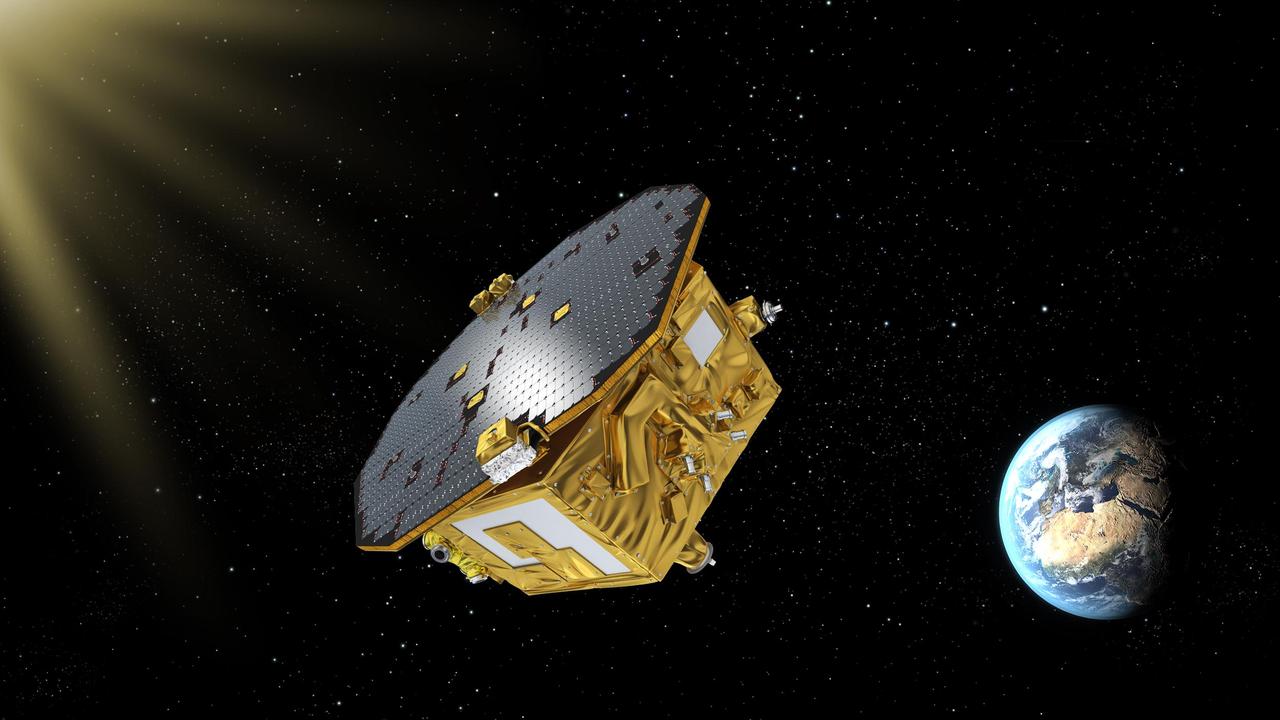
Space-based detection builds on technology tested by LISA Pathfinder, the mission shown in the featured image. The spacecraft demonstrated how to keep proof masses in near free fall and control disturbances that would otherwise overwhelm a gravitational-wave measurement. This is a different engineering challenge from LIGO, but the central idea is the same: use light to track a changing distance with extraordinary precision.

At still lower frequencies, pulsar-timing arrays use the regular pulses of rapidly rotating neutron stars as a galaxy-sized clock. Tiny changes in pulse arrival times can reveal a long-wavelength background produced by many massive black-hole binaries. Together, these approaches turn gravitational-wave astronomy into a spectrum rather than a single instrument.
What gravitational waves can teach us next
Every detection adds to a population of black holes and neutron stars. Their masses and spins reveal how stars live, die and pair up. Their locations trace galaxies that may be too faint or distant for easy identification. Their waveforms test gravity in the most extreme environments we can observe. They can also expose unexpected systems, such as mergers whose component masses do not fit neatly into existing stellar-evolution models.
The signals are not a replacement for images. A telescope shows color, shape and chemistry, while a gravitational wave measures bulk motion and the geometry of a violent event. Used together, they offer a more complete story. You can explore the site's interactive Solar System for nearby worlds, check the Astronomical Calendar for visible events, and return to our cosmic-rays guide for another example of how invisible particles carry information across space.
Frequently asked questions
Can humans hear a gravitational wave?
Not directly. A detector records changes in laser interference, and scientists can shift the measured waveform into the range of human hearing. The resulting sound is a way to represent the data, not a pressure wave that traveled through space into a microphone.
Are gravitational waves the same as gravity waves in an atmosphere?
No. Atmospheric gravity waves are fluid motions restored by buoyancy and gravity. Gravitational waves are ripples in spacetime predicted by general relativity. The similar names describe different physical phenomena.
Why are two LIGO detectors needed?
One detector cannot easily distinguish a cosmic signal from a local disturbance. The widely separated LIGO sites experience different earthquakes, traffic and weather. A real gravitational-wave signal should appear in both data streams with a consistent waveform and a physically possible arrival-time difference.
Can a backyard telescope see gravitational waves?
No. Gravitational waves are not visible light, and the changes they create are far too small for an optical telescope. Backyard observers can follow the electromagnetic afterglows of some events when astronomers publish a sky location, but the wave itself requires a specialized detector.
Sources & Further Reading
- LIGO Technology - How laser interferometers measure changes in arm length.
- LIGO's Dual Detectors - Why two separated observatories help identify real signals.
- LIGO: The First Detection - The 2015 black-hole merger and its significance.
- Why Detect Gravitational Waves? - What these signals reveal that light cannot.
- NASA Science: LISA - The planned space-based gravitational-wave observatory.
- NASA Science: LISA Pathfinder - Technology demonstration for space-based detection.