Auroras on Other Planets: How Alien Skies Make Their Own Light
Earth's northern and southern lights are not a one-planet phenomenon. Spacecraft and the Hubble Space Telescope have found auroras on Jupiter, Saturn, Mars, Uranus and even Venus. The light may be invisible ultraviolet instead of green to human eyes, and the engine may be a moon, a tilted magnetic field or a burst of solar wind. What unites these displays is a simple exchange: energetic charged particles reach an upper atmosphere, transfer energy to gas, and the gas releases some of that energy as light.
That makes an aurora more than a beautiful photograph. It is a remote diagnostic of a planet's magnetic environment, upper atmosphere and space weather. NASA's aurora overview explains the common physics, while missions such as Juno, Cassini and MAVEN show how different the same process can look on different worlds. In this guide, we will compare the best-studied planetary auroras and then use them to ask a bigger question: what can alien light tell us about a planet?
What makes an aurora?
An aurora begins with a population of charged particles, usually electrons or ions, moving through a planet's magnetosphere or the space around it. Magnetic fields do not simply pull particles straight down like gravity. They guide charged particles along field lines, causing them to spiral and funnel toward regions where those lines meet the upper atmosphere. When the particles collide with atmospheric atoms and molecules, they leave those particles in excited states. As the atmosphere returns to lower-energy states, it emits photons.
The color depends on the gas, altitude and particle energy. Oxygen and nitrogen give Earth's aurora its familiar green, red, blue and violet tones, but hydrogen-rich giant planets often produce strong ultraviolet emissions. A camera can therefore record a brilliant aurora that no human observer could see without an instrument sensitive to ultraviolet light. Images are also frequently mapped into visible colors so researchers can compare intensity and structure; the colors in a published image are not always what an astronaut would see.
The particle supply matters just as much as the atmosphere. At Earth, solar wind and geomagnetic storms can intensify the lights. At Jupiter, Saturn and Uranus, the solar wind interacts with the planetary magnetic field, but internal magnetospheric processes can dominate. A planet may even receive particles from a volcanic moon. That is why “aurora” describes a family of related phenomena rather than one universal recipe.
Jupiter: a magnetic powerhouse with moon-made fingerprints
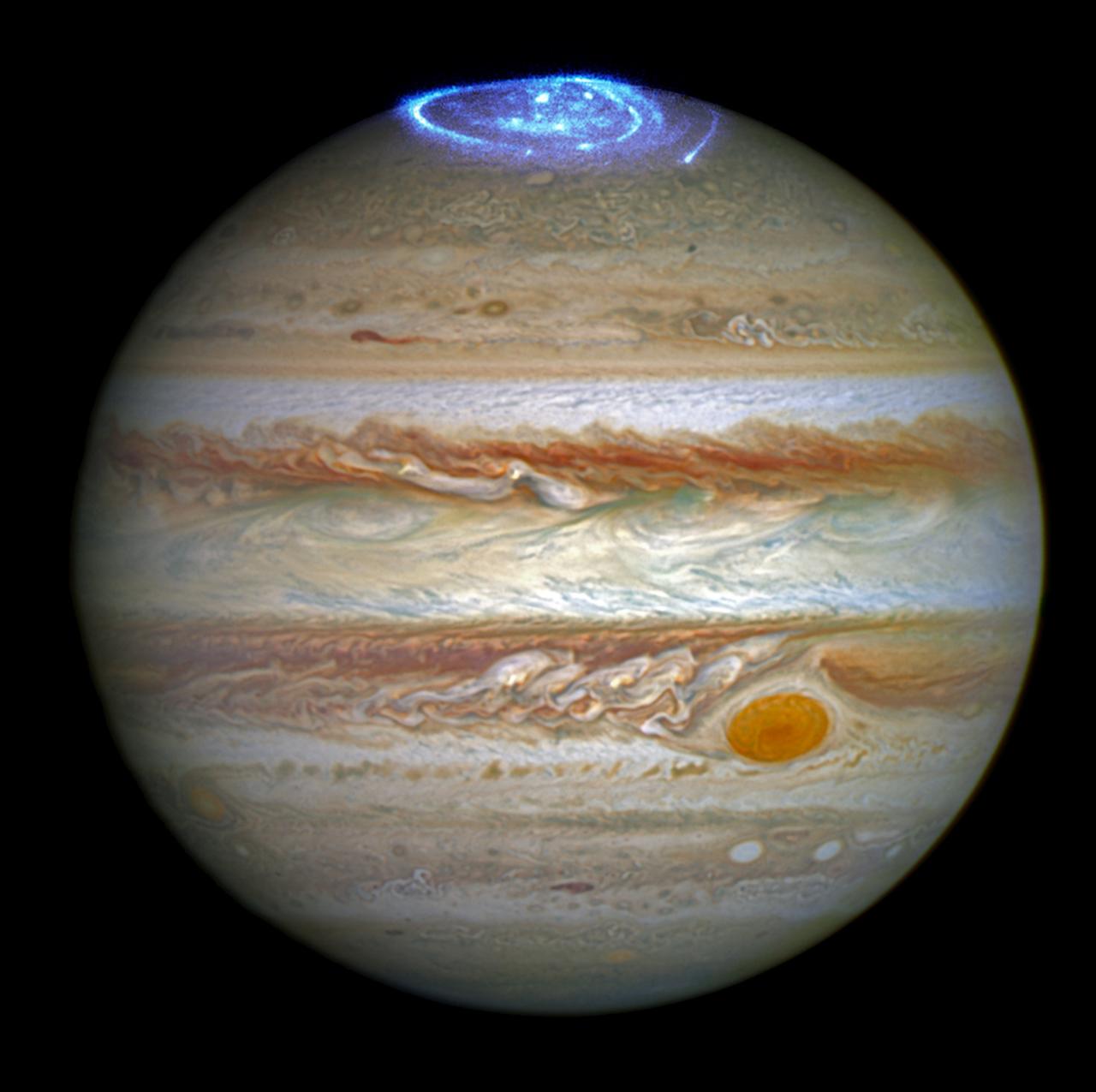
Jupiter hosts the brightest and most energetic auroras in the Solar System. Its magnetic environment is enormous, and its rotation takes roughly ten hours, forcing trapped plasma to circulate at extraordinary speed. Solar wind still changes the display, but Jupiter's auroral engine is not powered by the Sun alone. NASA's Hubble observations show that the volcanic moon Io leaves bright “footprints” outside the main auroral oval.
Io constantly loses material from its volcanic surface. Some of that material becomes ionized and is picked up by Jupiter's magnetic field. An electrical current then links Io and Jupiter along a magnetic flux tube. Where the current reaches the planet's upper atmosphere, it creates a localized auroral spot. The spot moves with Io's orbital position, while the main auroral oval follows Jupiter's rotation. In other words, the ultraviolet image contains a map of a planet, a moon and an electrical circuit at once.
Jupiter's large moons can also leave auroral signatures. In 2025, NASA reported that Juno data had identified the missing auroral footprint from Callisto, completing the set for the four Galilean moons. These footprints let scientists study how each moon interacts with the surrounding plasma. They also show why Jupiter is such a useful laboratory: the planet's aurora responds to both outside solar activity and the moving bodies embedded in its magnetosphere.

Saturn: auroras that do not simply copy Earth's
Saturn's auroras form high above the cloud tops and are most often observed in ultraviolet. Cassini and Hubble observations showed that Saturn's display is not just a scaled-up version of Earth's northern lights. NASA researchers found that Saturn's aurora can brighten as the planet's night side turns toward day, and that its structure is shaped by the planet's magnetic field, rotation and changing solar wind.
Saturn's rings add another layer of complexity. Ring particles interact with the surrounding plasma and can influence the chemistry and electrical environment above the planet. The rings do not act as a simple light source for the aurora, but they are part of the system that a spacecraft must account for when interpreting observations. The result is a dynamic polar glow whose brightness and shape can change on timescales much shorter than Saturn's seasons.
Because ultraviolet light is absorbed by Earth's atmosphere, Saturn's auroras are not a backyard telescope target. The best observations come from space telescopes and spacecraft. You can still explore Saturn visually through the site's backyard Saturn guide, but the auroral details require instruments that can see beyond visible light.
Mars: auroras without a global magnetic shield
Mars presents the most revealing contrast with Earth. The planet does not have a global magnetic field that wraps around it, although ancient crustal rocks preserve localized magnetic fields. The solar wind therefore interacts directly with the Martian space environment in ways that are impossible on Earth. NASA's MAVEN mission found that Mars can produce several kinds of aurora, including proton aurora and discrete ultraviolet aurora associated with crustal magnetic fields.
Proton aurora begins with solar-wind hydrogen. Some protons capture electrons from hydrogen in Mars' upper atmosphere and become neutral hydrogen atoms. Because neutral atoms are not deflected by the bow shock in the same way as charged particles, they can penetrate deeper toward the dayside atmosphere. When they collide and slow down, they produce ultraviolet emission. NASA's MAVEN observations describe this as a process that allows solar-wind energy to reach Mars even without a global magnetic field.
During strong solar storms, the aurora can spread across much of the planet's dayside. In 2022, MAVEN and the Emirates Mars Mission reported patchy proton aurora that revealed turbulent, changing conditions around Mars. These events are scientifically important because the same solar-wind interaction that makes the ultraviolet glow can also contribute to atmospheric escape. An aurora on Mars is therefore both a light show and a tracer of the processes that have changed the planet's atmosphere over time.

Uranus: a tilted magnetosphere in a tilted world
Uranus is already unusual before its aurora turns on. The planet rotates nearly on its side, and its magnetic field is strongly tilted and offset from the planet's center. Auroras therefore do not sit neatly over geographic north and south poles. Hubble observations have tracked auroral emissions far from the locations an Earth-based observer might expect, helping scientists recover the orientation and rotation of Uranus' magnetic system.
Long-term monitoring makes Uranus especially valuable. A 2025 NASA Hubble study used more than a decade of auroral observations to refine the planet's interior rotation period. More recent infrared work with the James Webb Space Telescope is probing Uranus' upper atmosphere and ionosphere, where auroral energy is deposited. These observations connect a faint ultraviolet or infrared signal to the hidden circulation of an ice giant that has been visited closely only once.
What planetary auroras can tell us about distant worlds
Auroras offer a way to study a planet without landing on it. Their location traces magnetic field geometry. Their changing brightness records the supply of charged particles. Their spectrum reveals which gases are present high in the atmosphere. Together, those clues can constrain whether a planet has an intrinsic magnetic field, how its upper atmosphere responds to stellar activity, and whether a moon or ring system is feeding plasma into the magnetosphere.
This is why aurora research matters for exoplanets. A distant planet's magnetic field is difficult to measure directly, but radio or optical emission linked to star-planet interactions may provide indirect evidence. The interpretation is not automatic: flares, stellar activity and other atmospheric processes can mimic some signals. Researchers therefore combine auroral candidates with orbital information, spectra and repeated observations rather than treating one flash as proof of a magnetic field.
For practical observing, the lesson is simple: the most dramatic auroras beyond Earth are generally invisible to the naked eye. The best way to experience them is through mission data and carefully processed images. You can use the site's interactive 3D Solar System to place these worlds in context, then check the Astronomical Calendar for events you can actually observe from Earth. If Mars is your next target, our Mars observing guide explains what a backyard telescope can realistically show.
Frequently asked questions
Can you see Jupiter's aurora through a backyard telescope?
No. Jupiter's main aurora is strongest in ultraviolet wavelengths, which Earth's atmosphere blocks and human eyes cannot see. A telescope can show Jupiter's cloud belts and moons, but auroral structure requires space-based instruments or spacecraft data.
Which planet has the strongest aurora?
Jupiter is the strongest known planetary auroral system in our Solar System. Its rapid rotation, huge magnetic field and plasma supplied by Io create an environment far more energetic than Earth's. “Strongest” here refers to the energy and brightness measured by instruments, not to a display visible from a neighboring planet.
Does Mars have auroras if it lacks a global magnetic field?
Yes. Mars has proton auroras driven by solar-wind hydrogen, as well as other auroral emissions shaped by crustal magnetic fields and local space weather. Their mechanisms differ from Earth's, which is exactly why MAVEN observations are so useful.
Sources & Further Reading
- NASA Science: Auroras — Overview of auroral physics and planetary examples.
- NASA Hubble: Jupiter's Auroras — Io's volcanic material and auroral footprints.
- NASA Juno: Auroral Signatures from Jupiter's Moons — Moon-magnetosphere interactions.
- NASA Hubble: Saturn's Auroras — How Saturn's polar emissions differ from Earth's.
- NASA MAVEN: Proton Aurora at Mars — Why Mars can make auroras without a global magnetic field.
- NASA Hubble: Uranus Auroras and Rotation — Long-term auroral monitoring of the ice giant.