How to Observe Saturn & Its Rings: The Ultimate Backyard Telescope & Stargazing Guide
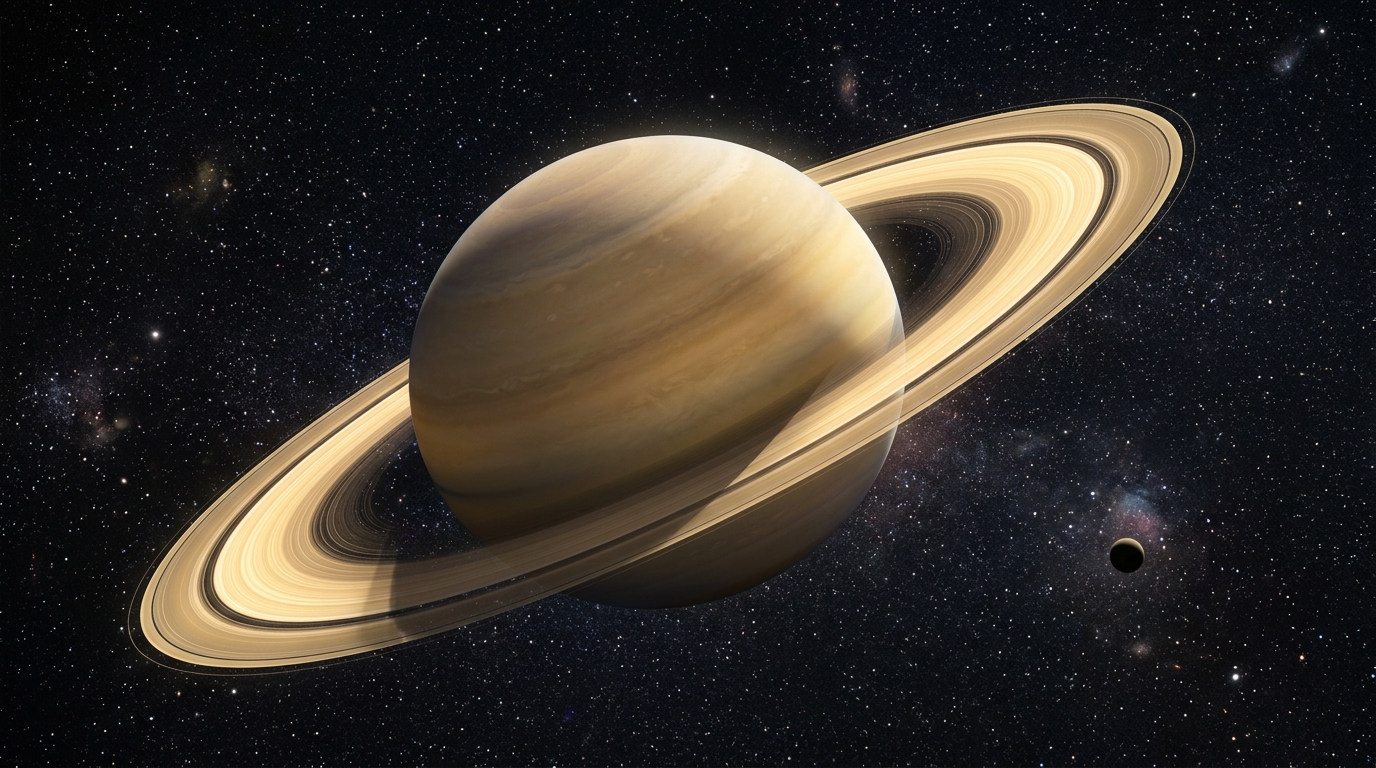
Seeing Saturn through an eyepiece for the very first time is a transformative milestone for any stargazer. Unlike nebulas or faint galaxies that often appear as misty gray smudges to the human eye, Saturn delivers an unmistakable, three-dimensional jewel hanging in pitch-black space. Its golden pastel globe, delicate shadow play, and luminous concentric rings look so astonishingly crisp that beginners frequently suspect a sticker has been placed inside the telescope tube.
However, extracting maximum planetary detail—such as the razor-thin Cassini Division, atmospheric cloud belts, the enigmatic Crepe Ring, and orbiting ice moons—requires thoughtful planning. From choosing the correct eyepiece focal lengths to mastering atmospheric seeing and navigating Saturn's periodic ring plane crossings, this comprehensive Saturn observation guide equips you with everything needed for awe-inspiring backyard views.
✦ Quick Answer: How to Observe Saturn in 4 Key Steps
- Minimum Optics: A modest 60mm–70mm refractor at 25x–50x magnification easily reveals Saturn's ring system as an oval disk. To resolve the dark Cassini Division and cloud bands, use a 100mm (4-inch) or larger aperture telescope at 120x–200x.
- Can Binoculars See the Rings?: Standard 10x50 binoculars show Saturn as an elongated golden oval or saucer shape. Heavy tripod-mounted 20x80 binoculars can just barely separate the ring tips from the planetary disc.
- Best Observing Window: Observe during Saturn's annual opposition (when Saturn is closest to Earth and visible all night) and when the planet crosses your local meridian at highest altitude.
- Beware the Ring Tilt: Saturn's rings tilt on a 29.4-year cycle. Every 13.7 to 15.7 years, they turn completely edge-on to Earth, becoming a hair-thin line before opening back up over subsequent seasons.
Anatomy of the Ringed Giant: What Are You Actually Looking At?
Saturn is the sixth planet from our Sun and the second largest in our solar system. Despite its immense volume—over 760 Earths could fit inside—it is the least dense planet in the solar system, composed predominantly of hydrogen and helium with a density lower than liquid water.
What makes Saturn universally captivating is its extraordinary ring system. Spanning more than 282,000 kilometers (175,000 miles) across, the main rings are astonishingly thin—often measuring less than 10 to 30 meters (30 to 100 feet) in vertical thickness. They are composed of billions of individual particles of water ice (99% purity) with trace silicate dust, ranging in size from microscopic frost grains to house-sized icy boulders.
You can interactively explore Saturn's orbital distance, planetary inclination, and surrounding moons inside our interactive 3D Solar System Explorer.

The Major Ring Structures Visible from Earth
- Ring A (Outer Ring): The outermost prominent ring visible in amateur telescopes. It appears slightly dimmer than Ring B and contains the narrow Encke Gap near its outer edge.
- Cassini Division: A striking 4,800 km (2,980 mi) gap separating Ring A and Ring B. It is not empty space, but rather a region cleared of particles by orbital resonances with Saturn's moon Mimas.
- Ring B (Middle Ring): The brightest, widest, and most massive component of the ring system, reflecting brilliant sunlight back toward Earth.
- Ring C (Crepe Ring): A faint, semi-transparent inner ring extending toward Saturn's cloud tops. It requires at least an 8-inch (200mm) aperture and steady atmospheric seeing to discern as a smoky veil across the planet's equator.
Did You Know? When Galileo Galilei first pointed his primitive 20x spyglass at Saturn in 1610, he couldn't resolve the rings. He described Saturn as having "three bodies" or "ears." When the rings tilted edge-on in 1612 and vanished from sight, a bewildered Galileo famously lamented: "Has Saturn swallowed his children?" in reference to ancient Roman mythology.
Telescope Equipment Guide: What You Can See by Aperture
How much detail you can resolve on Saturn depends primarily on your telescope's optical aperture (diameter of the primary lens or mirror) and the atmospheric stability of your night sky:
| Optical Instrument | Aperture / Spec | Magnification | Observable Saturnian Features |
|---|---|---|---|
| Standard Binoculars | 7x50 or 10x50 | 7x - 10x | Golden star-like disc; hints of elongation or oblong saucer shape; Titan visible as a faint pinpoint. |
| Giant Astro Binoculars | 15x70 or 20x80 (on tripod) | 15x - 20x | Clean separation of the ring ears (ansae) from the planetary ball; bright moon Titan clearly held in view. |
| Small Refractor / Tabletop | 60mm - 80mm (2.4" - 3.1") | 40x - 90x | Distinct separation between globe and rings; dark shadow of the globe cast across the ring plane; golden equatorial hue. |
| Medium Scope (Dobsonian / SCT) | 100mm - 150mm (4" - 6") | 120x - 180x | Sharp Cassini Division in the ring ansae; North Equatorial Belt (NEB); 3 to 4 moons (Titan, Rhea, Tethys, Dione). |
| Large Aperture Scope | 200mm - 300mm+ (8" - 12"+) | 200x - 320x | Cassini Division traced completely across the front; subtle Crepe Ring (Ring C); multiple cloud zones; polar hexagon zone hints; 5 to 6 moons including Iapetus and Enceladus. |
Magnification & Eyepiece Mathematics for Planetary Observers
A common pitfall for beginners is buying ultra-high magnification eyepieces that produce dark, blurry, vibrating images. Planetary stargazing requires balanced magnification governed by physics and Earth's turbulent atmosphere.
The Two Golden Formulas of Telescope Optics:
- Magnification Power ($M$): Calculated by dividing the telescope's focal length by the eyepiece focal length:
Magnification = Telescope Focal Length (mm) / Eyepiece Focal Length (mm)
Example: A 1200mm focal length telescope with a 10mm eyepiece produces $1200 / 10 = 120\times$ magnification. - Maximum Useful Magnification: As a strict optical rule, a telescope cannot cleanly magnify past $50\times$ per inch of aperture (or roughly $2\times$ per millimeter of aperture under pristine atmospheric conditions). A 100mm (4-inch) scope caps out around $200\times$, regardless of what marketing claims on cheap department store boxes promise.
For most backyard observers, the sweet spot for Saturn lies comfortably between $130\times$ and $220\times$. Beyond $250\times$, atmospheric turbulence (poor "seeing") causes the image to boil and lose sharpness unless you are observing from high-altitude mountaintops or exceptionally calm ocean air currents.
The 29.4-Year Ring Tilt Cycle: Why Saturn's Rings "Disappear"
Saturn is tilted on its rotational axis by approximately 26.73° relative to its orbital plane around the Sun (very similar to Earth's 23.4° tilt). Because Saturn takes 29.4 Earth years to complete one single journey around the Sun, our perspective of its ring system shifts dramatically over the decades.
To understand the massive scale of planetary orbits and how time flows on outer worlds, calculate your birthday on the ringed planet with our Age on Other Planets Calculator.
During Saturnian solstices, the rings are tilted at their maximum angle toward Earth (up to 27 degrees wide open), giving us spectacular, panoramic views of the entire ring architecture. However, during Saturnian equinoxes—occurring every 13.7 to 15.7 Earth years—the paper-thin rings align edge-on directly with Earth's line of sight.
During a Ring Plane Crossing, the rings virtually vanish in small and medium telescopes, leaving Saturn looking like an unadorned ball of butterscotch cream. While this disappoints casual stargazers looking for giant halos, experienced planetary observers cherish ring-plane crossings because the glare of the rings disappears, making it substantially easier to spot Saturn's faint, inner ice moons like Enceladus, Mimas, and Tethys!
| Saturnian Phenomenon | Cycle Phase | Visual Appearance from Earth | Best Target to Observe |
|---|---|---|---|
| Maximum Ring Open Tilt | Solstice (~27° tilt) | Expansive, brilliant rings fully showcasing Cassini Division and A/B rings. | Cassini Division, Ring C, shadow geometry. |
| Intermediate Inclination | Mid-Season (10° - 18° tilt) | Classic oval ring silhouette framing the planetary disk. | Cloud belts and ring shadow interactions. |
| Edge-On Ring Plane Crossing | Equinox (0° edge-on) | Rings become a razor-thin needle line or completely disappear. | Faint moons (Enceladus, Mimas) and polar regions. |
How to Spot Saturn’s Moons from Your Backyard
Saturn boasts over 140 recognized moons, but five to six of them are readily accessible through amateur backyard equipment:
- Titan (Magnitude +8.5): Saturn's largest moon—larger than the planet Mercury and the only moon in the solar system with a dense nitrogen atmosphere. Titan is bright enough to be seen with simple 10x50 binoculars or any 60mm telescope, orbiting Saturn every 16 days at up to 5 ring-diameters away.
- Rhea (Magnitude +9.7): Saturn's second-largest moon, easily spotted in a 90mm or 100mm telescope hovering close to the outer rings.
- Tethys (Magnitude +10.2) & Dione (Magnitude +10.4): Bright icy worlds orbiting inside Rhea's path. Visible in 100mm to 150mm scopes on steady nights.
- Iapetus (Magnitude +10.2 to +11.9): The famous "two-faced" yin-yang moon. Because one hemisphere is coated in dark carbonaceous dust while the other is pure reflective ice, Iapetus is significantly brighter when located west of Saturn than when it is to the east.
- Enceladus (Magnitude +11.7): The active ocean world with cryogenic geysers. Requires an 8-inch (200mm) or larger telescope and calm skies to isolate from Saturn's bright ring glare.
✦ Essential Stargazing Checklist for Observing Saturn
Color Filters & Astrophotography: Capturing the Golden Planet
Unlike deep-sky objects that require minutes-long single exposures, planetary imaging relies on a technique called "Lucky Imaging."
Because Earth's atmosphere constantly shimmers and distorts the incoming light waves, long camera exposures will always appear blurry. Modern planetary astrophotographers attach dedicated high-speed CMOS planetary cameras (or even mirrorless cameras and smartphones with afocal adapters) to capture uncompressed 4K video clips at 60 to 120 frames per second for 2 to 3 minutes.
Freeware astronomical stacking software (such as AutoStakkert! and RegiStax) analyzes every individual video frame, selects the top 5% to 10% sharpest frames that were captured during split-second moments of atmospheric stillness, and stacks them together into a pristine, high-signal master image ready for wavelets sharpening.
To plan your planetary observation sessions around upcoming astronomical conjunctions and oppositions, consult our Astronomical Events Calendar.
Frequently Asked Questions (FAQ)
Can you see Saturn’s rings with the naked eye?
No. To the unaided human eye, Saturn appears as a steady, golden star with an apparent magnitude ranging between 0.0 and +1.0. Because human optical resolution is limited to about 60 arcseconds, you need at least 20x to 30x optical magnification (providing around 40 arcseconds of ring span) to resolve the separation between the planet and its rings.
What causes the "Seeliger Effect" during Saturn's opposition?
During the days immediately surrounding opposition, Saturn's rings brighten noticeably compared to the planetary ball. This surge in luminosity—known as the Seeliger Effect or opposition surge—occurs because shadows cast by tiny icy particles in the rings fall directly behind the particles from our vantage point, eliminating visible shadow and causing coherent retro-reflection of sunlight straight back to Earth.
Why does Saturn look blurry or swim in my telescope eyepiece?
Blurry, boiling images are almost always caused by two factors: poor atmospheric seeing (thermal air currents in the upper atmosphere or jet stream) or a warm telescope mirror that has not acclimated to ambient outdoor temperatures. Allow your telescope 45 minutes to cool down, and avoid observing over heat-radiating roofs, asphalt driveways, or building chimneys.
Are Saturn's rings permanent, or will they disappear in the future?
Planetary data from NASA's Cassini mission confirmed that Saturn's rings are relatively young (likely 100 to 400 million years old) and are actively being drained away by a phenomenon called "ring rain"—water ice pulled into Saturn's upper atmosphere by gravity and magnetic fields. Astronomers estimate the rings may completely dissipate within the next 100 to 300 million years.
Further Reading & Authoritative Astronomy Resources
To expand your planetary exploration skills and keep up with real-time planetary observation campaigns, explore these authoritative scientific resources:
- NASA Science: Saturn Planetary Profile — Official mission data, Cassini-Huygens findings, and high-resolution imaging archives.
- Association of Lunar and Planetary Observers (ALPO) — Global amateur planetary observing sections, transit timings, and Saturnian storm tracking.
- Sky & Telescope Saturn's Moons Locator — Interactive orbital utility for identifying Titan, Rhea, Dione, and Tethys in real time.
- NASA Cassini-Huygens Mission Legacy — Detailed scientific breakdowns of Saturn's magnetosphere, rings, and oceanic moons.
Set up your telescope under the open stars, let your optics cool, dial in focus on the golden jewel of our solar system, and marvel at the cosmic splendor of Saturn!