How to Observe Venus & Its Phases: The Ultimate Backyard Telescope & Stargazing Guide
Hanging like a brilliant lantern of pure silver in the twilight sky, Venus is the undisputed monarch of the night and morning sky. Outshining every other celestial body except the Sun and Moon, our inner sister planet blazes between magnitude -4.0 and a staggering -4.9—so dazzling that in pristine dark-sky conditions, a razor-thin crescent Venus can actually cast a faint, perceptible shadow across the Earth.
Known across millennia as both the Evening Star (Hesperus) and the Morning Star (Phosphorus), Venus holds a uniquely electrifying place in the history of human consciousness. When Galileo Galilei aimed his primitive thirty-power spyglass toward Venus in the autumn of 1610, what he saw permanently dismantled our understanding of reality. Instead of a perpetual sphere, Galileo witnessed Venus waxing and waning through a full sequence of lunar-like phases: from a tiny full orb, to a clean half-moon (dichotomy), to a colossal, slender crescent. Because Venus showed a complete cycle of phases while drastically swelling in size, it was physical, undeniable mathematical proof that Venus revolved around the Sun—not Earth—forever shattering the Ptolemaic geocentric universe.
Yet for modern amateur astronomers setting up a backyard telescope, Venus is famously both the easiest planet to find and the most challenging to observe cleanly. Point an ordinary eyepiece at Venus against a pitch-black midnight sky, and you will likely be greeted by an agonizing, blinding flare of bleached light, surrounded by distracting purple halos and optical glare. In this comprehensive backyard Venus observing guide, we will explore the celestial orbital geometry that generates its phases, the secret counter-intuitive method of observing in daylight and twilight, the specialized optical filters that unlock subtle cloud banding, and the ongoing mystery of the ghostly Ashen Light.
✦ Quick Answer: How to Observe Venus in 4 Key Steps
- Can You See Venus's Phases with Binoculars?: Yes! When Venus is in its crescent phase nearing inferior conjunction, its apparent diameter swells to over 50 arcseconds (almost as large as Jupiter). In steady, tripod-mounted 10x50 or 15x70 binoculars, the crescent curve is readily visible to the human eye.
- Minimum Telescope Needed: Any modest 60mm to 80mm refractor or 4-inch reflector at 40x to 100x magnification will cleanly resolve every phase of Venus—from gibbous to half to razor-thin sickle. High apertures (6" to 10") reveal delicate cloud shading along the terminator.
- The Golden Rule: Observe in Twilight or Broad Daylight: Never observe Venus in a pitch-black sky! Its blinding surface albedo (76% reflectivity) overpowers your eye's retina and triggers severe glare and chromatic aberration. By observing during sunset, sunrise, or afternoon twilight, the bright sky background balances the contrast, revealing crisp, sharp phase edges.
- Tame the Glare with Filters: Screw a Variable Polarizing filter or Neutral Density (ND96) filter into your eyepiece to dial down intensity. To detect subtle darker cloud formations in the upper sulfuric-acid atmosphere, use a Wratten #80A Light Blue or #47 Deep Violet filter.
The Dance of the Inferior Planet: Understanding Venus's 584-Day Synodic Cycle
Because Venus orbits closer to the Sun than Earth (at an average distance of 108 million kilometers or 0.72 AU), it is classified as an inferior planet. This fundamental orbital geometry dictates two profound rules that govern everything you see through an eyepiece:
- Venus Never Strays Far from the Sun: Unlike Mars, Jupiter, or Saturn, which can wander 180 degrees away to stand high in the midnight sky at opposition, Venus is tethered to the Sun. Its maximum apparent separation—known as Greatest Elongation—never exceeds approximately 47 degrees. Consequently, Venus is only ever seen low in the western sky after sunset or in the eastern sky before sunrise (or in broad daylight).
- The Apparent Diameter and Phase Inversion: As Venus orbits the Sun, its distance from Earth fluctuates wildly—from a distant 261 million km across the solar system down to a mere 40 million km (the closest any major planet gets to Earth). This creates a striking paradox: when Venus is most illuminated (Full), it is furthest and smallest; when it is least illuminated (a slender crescent), it is closest and largest!
Track Venus's orbital mechanics in real-time with our interactive 3D Solar System Simulator.

The Four Key Stations of the Venusian Phase Cycle
Over a period of approximately 584 days (the synodic period), Venus cycles through four critical orbital stations that offer distinct views for stargazers:
- Superior Conjunction (The Distant Full Disc): Venus is on the far side of the Sun, directly opposite Earth. It shines with 100% illumination, but its disc shrinks to a minuscule 9.7 arcseconds across. Because it lies right behind the Sun, it is virtually unobservable.
- Greatest Eastern Elongation (The Half-Moon Evening Star): Venus swings wide to the east of the Sun, setting up to 3 to 4 hours after dusk. Through a telescope, Venus appears as a clean 50% illuminated half-disc (Dichotomy) measuring approximately 24 to 26 arcseconds across. This is prime observing season!
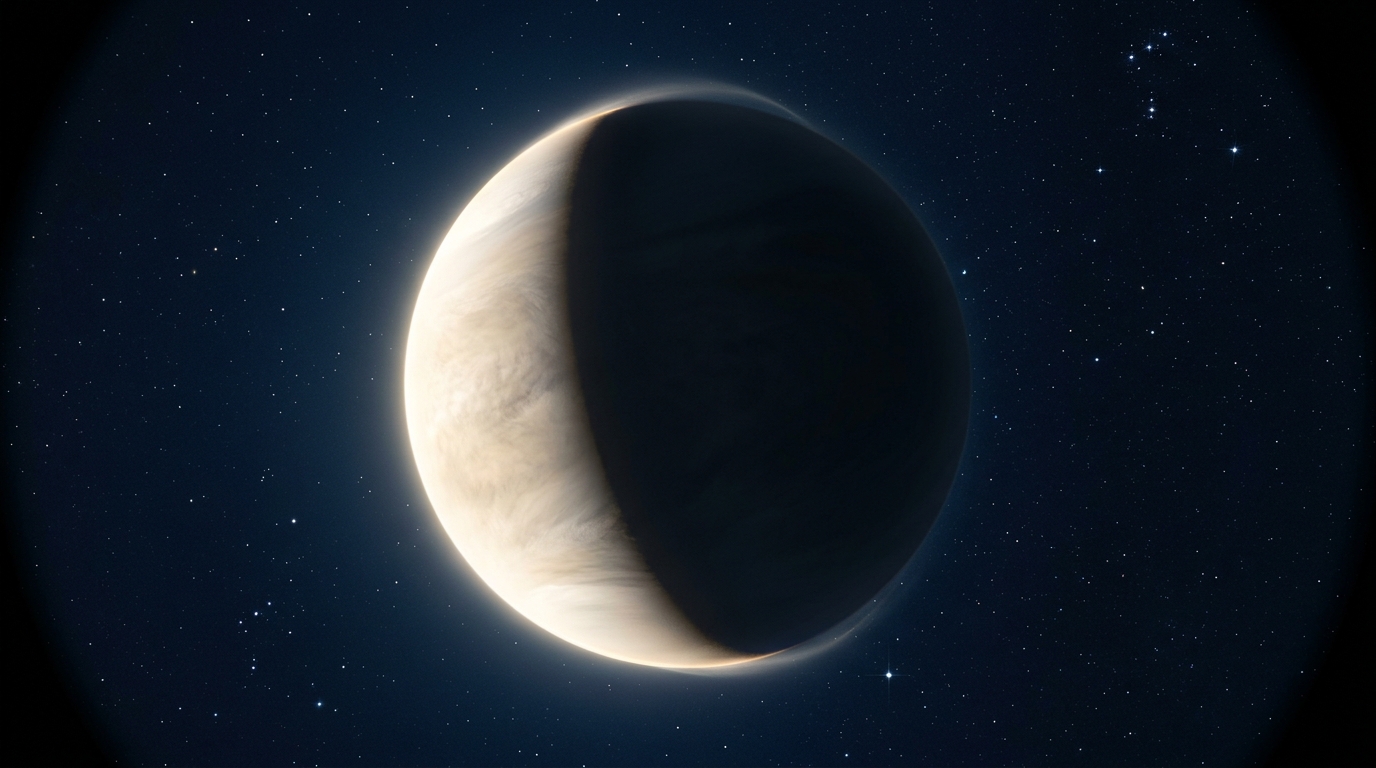
- Greatest Brilliancy (The Crescent King): About 36 days after eastern elongation, Venus reaches its dazzling peak brightness of magnitude -4.85. At this point, Venus is a dramatic 25% illuminated crescent, but because it has drawn much closer to Earth, its apparent disc has swelled to over 40 arcseconds! The immense surface area of this glowing crescent creates maximum reflective light.
- Inferior Conjunction (The Colossal Sickle): Venus passes between Earth and the Sun. Its illuminated face turns away from us, shrinking to a 1% to 2% hair-thin crescent that spans an astonishing 60 to 64 arcseconds across—larger in apparent width than giant Jupiter!
| Phase Station | Illumination % | Apparent Diameter | Visual Magnitude | Best Telescope Strategy |
|---|---|---|---|---|
| Superior Conjunction | 100% (Full) | ~9.7″ | -3.9 | Extremely close to Sun; not recommended for viewing. |
| Gibbous Phase | 85% – 60% | 12″ – 20″ | -4.0 | Small, intense disc; best viewed at 100x–150x with neutral density filter. |
| Greatest Elongation (Dichotomy) | 50% (Half) | 24″ – 26″ | -4.3 | Half-moon shape; look for terminator roughness and cloud shading. |
| Greatest Brilliancy | ~25% (Crescent) | 38″ – 44″ | -4.85 | Dazzling crescent; resolve easily in small refractors & binoculars. |
| Inferior Conjunction | 5% – 1% (Thin Sickle) | 55″ – 64″ | -4.2 | Massive, graceful crescent; inspect for extended cusps and atmospheric glow. |
The Number One Pro-Tip: Observe Venus During Twilight or Daylight
Ask an experienced planetary observer for their number one rule on viewing Venus, and they will answer without hesitation: never wait for a dark sky!
Venus is blanketed by continuous, unbroken clouds of concentrated sulfuric acid droplets suspended in a dense carbon dioxide atmosphere. This reflective shield has a geometric albedo of 0.76, meaning it bounces back over three-quarters of all the sunlight that strikes it. When viewed against a pitch-black night sky, this blinding brilliance produces two optical handicaps:
- Visual Irradiation: In the human eye, extremely bright light against total darkness bleeds across neighboring retinal photoreceptors, causing the planetary limb to bloat, boil, and appear smeared with phantom spikes.
- Atmospheric Dispersion & Low Altitude: By the time full night falls, Venus has sunk low toward the horizon (typically under 15 degrees altitude). Looking through thick, churning layers of ground air causes the planet to twinkle erratically and refract into false rainbows (red on top, blue on the bottom).
By observing Venus 30 to 60 minutes before sunset or in early civil twilight, the bright sky background acts as a natural neutral density filter. Contrast is normalized, chromatic aberration vanishes, and the razor-sharp geometric curve of the limb stands out like carved porcelain.
⚠️ Critical Solar Safety Warning for Daytime Viewing
Observing Venus in broad daylight when it is high above turbulent horizon air yields spectacular, rock-steady views. However, NEVER attempt daytime solar-proximity observing unless you are an experienced astronomer. If your telescope accidentally sweeps across the Sun, even for a microsecond, the focused solar rays will cause instantaneous, irreversible blindness or permanently melt your optical equipment. Always position your telescope in the shadow of a building or high wall that completely blocks the Sun's line of sight!
Atmospheric Curiosities: What Can You Actually See on Venus?
While Mars displays rock-hard geological features like canyons and polar dry-ice caps, Venus is a dynamic ocean of clouds. The upper atmosphere rotates around the planet once every 4 Earth days in a phenomenon known as atmospheric super-rotation (moving sixty times faster than the solid surface below!). Here are the subtle atmospheric details you can detect with careful telescope observation:
1. The Cusp Extensions & Atmospheric Halo
When Venus is within a few weeks of inferior conjunction and its crescent dwindles to under 5% illumination, examine the tips of the crescent (the cusps or horns). Instead of terminating sharply at 180 degrees like the Moon's crescent, you will often notice the slender sliver of light curving 200 degrees or more around the planetary limb! In rare instances, when Venus passes within a few degrees of the Sun, the crescent joins into a complete, ethereal 360-degree glowing ring of light. This is caused by sunlight refracting through Venus's dense, upper atmosphere, bending around the night hemisphere toward Earth.
2. The Cusp Caps and Collars
With an aperture of 100mm (4 inches) or greater, observers frequently report bright white patches concentrated directly at the northern and southern cusps of the crescent. Known as polar cusp caps, these are vast, permanent polar vortex cloud structures in Venus's upper troposphere. Bordering these bright caps, you can often detect faint, dusky dark rings termed polar collars.
3. Schroeter’s Effect: The Dichotomy Mystery
In 1793, German astronomer Johann Schröter made a baffling discovery that has intrigued backyard observers ever since: observed dichotomy (the exact 50% half-phase) never occurs on the exact mathematically predicted date! During evening apparitions, the observed half-phase arrives several days earlier than celestial mechanics predicts; during morning apparitions, it arrives several days later. Why? The subtle shading along the terminator caused by twilight absorption in Venus's thick clouds makes the boundary appear slightly darker than it truly is, deceiving our eyes into seeing a crescent before the planet has reached exact geometric half-phase.
4. The Mysterious "Ashen Light"
One of the most persistent unsolved puzzles of amateur astronomy is the Ashen Light (Lumière Cendrée). First recorded in 1643 by Giovanni Riccioli, hundreds of seasoned observers—including Sir William Herschel and Sir Patrick Moore—have reported seeing a faint, ghostly, greenish-gray glow illuminating the unlit dark side of Venus during crescent phases, reminiscent of the "earthshine" on the Moon.
Unlike the Moon, however, Venus has no companion world to bathe its night side in reflected sunlight. While modern spacecraft have detected intense nighttime thermal glow in the infrared and continuous electrical lightning discharges in the sulfuric acid clouds, controversy still swirls over whether the Ashen Light seen in eyepieces is a real photochemical airglow event, a high-altitude auroral storm, or an optical illusion generated by human retinal contrast against the blazing crescent.
The Essential Eyepiece Filter Guide for Venus
Because Venus is so relentlessly luminous, optical color and density filters are not an optional luxury—they are an indispensable requirement for serious observation. Screwing the proper filter into your eyepiece thread performs miracles for planetary definition:
- Variable Polarizing Filter (The Glare Tamer): Composed of two polarizing elements that rotate relative to each other, this filter allows you to continuously dial down transmission from 40% down to 1%. It effortlessly strips away blinding irradiation without altering the natural pearl coloration of the planet.
- Wratten #80A (Light Blue): One of the premier planetary filters for Venus. The blue tint enhances the contrast of subtle atmospheric cloud shadings and dark horizontal belts, while slightly attenuating the intense yellow-white solar reflection.
- Wratten #47 (Deep Violet): For apertures of 8 inches (200mm) and larger, a deep violet filter transmits light down to 400nm, closely matching the ultraviolet wavelengths where Venus’s mysterious dark cloud chevrons and Y-shaped cloud structures absorb light!
- Wratten #15 (Deep Yellow) or #21 (Orange): Ideal when observing Venus low in twilight. Yellow and orange filters penetrate through terrestrial atmospheric haze, steadying image jitter and sharpening the limb boundaries.
✦ Stargazer’s Pre-Observation Checklist for Venus
Frequently Asked Questions (FAQ)
Why does Venus look like a blinding, blurry flare in my telescope?
This is the most common beginner frustration! If you observe Venus against a dark sky, its high albedo (76% reflectivity) overpowers your eye's dark adaptation, while low-altitude atmospheric turbulence causes severe boiling and false color fringing. Move your observing session into early twilight, observe while the sky is still pale blue, and use a variable polarizing filter or neutral density filter to tame the light.
Can you see the surface features (mountains, volcanoes) of Venus?
No optical telescope on Earth or in orbit can see the solid surface of Venus. The planet is entirely entombed in a permanent, 20-kilometer-thick shroud of opaque sulfuric acid and sulfur dioxide clouds. The mountains and vast volcanic plains of Aphrodite Terra and Maxwell Montes were mapped using radar wavelengths by missions like NASA’s Magellan and ESA’s Venus Express.
How often does Venus transit across the Sun?
Transits of Venus—where the black silhouette of Venus marches across the solar disc—are among the rarest predictable astronomical phenomena in history. They occur in a curious 243-year pattern of pairs separated by 8 years, followed by long intervals of 121.5 and 105.5 years. The most recent transits occurred in June 2004 and June 2012; unfortunately, the next transit of Venus will not occur until December 11, 2117!
Can you photograph Venus’s cloud features with a planetary webcam?
Yes! Amateur astrophotographers regularly capture remarkable cloud structures on Venus. The secret is to attach a dedicated Ultraviolet (UV) Pass filter (such as the Baader U-Filter transmitting around 350nm) to a sensitive monochrome high-speed CMOS planetary camera. In ultraviolet light, an unknown chemical absorber in Venus’s upper clouds reveals dramatic sweeping planetary chevrons and dark equatorial bands.
Conclusion: Reliving the Copernican Revolution
Few sights in amateur astronomy bridge the gap between pure visual elegance and historical drama as powerfully as Venus. When you center that delicate, gleaming crescent in your eyepiece, you are not merely looking at an alien world; you are retracing the very footsteps of Galileo Galilei on the balcony of his villa in Arcetri four centuries ago.
Whether you catch Venus as a graceful evening jewel sinking into the gold and crimson hues of sunset or as a blazing morning sentinel greeting the dawn, take a moment to savor its changing geometry. Clear skies, steady seeing, and happy stargazing!