How to Observe Jupiter & Its Moons: The Ultimate Backyard Telescope & Stargazing Guide
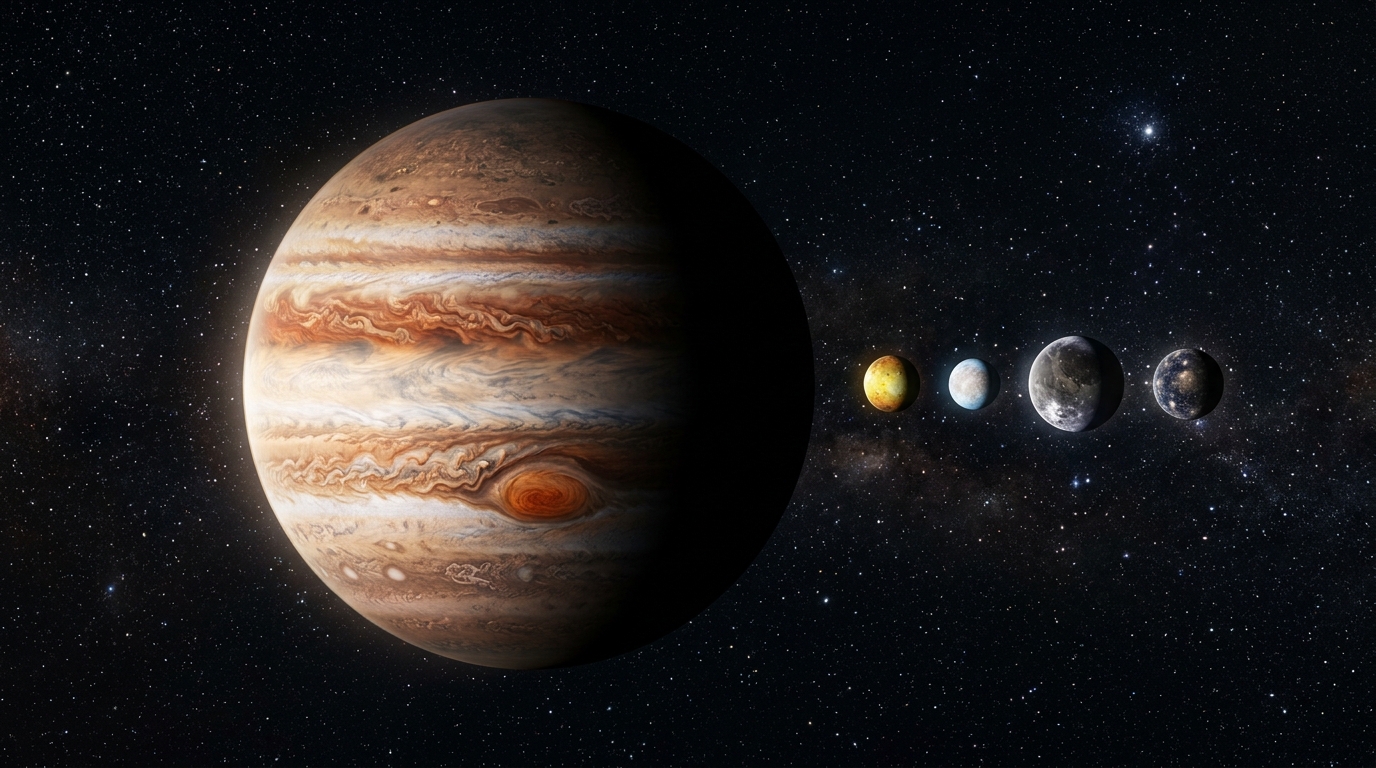
If Saturn is the crown jewel of the night sky, Jupiter is its undisputed monarch. Blazing across the ecliptic with an incandescent cream-white brilliance, Jupiter outshines every fixed star in the heavens. But the real spectacle begins the moment you center this gas giant in an optical eyepiece. Even through modest optics, Jupiter is not a static ball of light: it is a living, churning atmospheric colosseum of caramel-colored cloud belts, curling white storms, and four bright worlds pirouetting in perpetual gravitational ballet.
Unlike distant deep-sky nebulas that demand pitch-black wilderness skies, Jupiter is impervious to urban light pollution. You can study its complex cloud dynamics, trace the centuries-old Great Red Spot, and clock lunar shadow transits directly from a suburban patio or apartment balcony. In this definitive backyard Jupiter stargazing guide, we explore everything you need to observe the King of Planets like a seasoned amateur astronomer.
✦ Quick Answer: How to Observe Jupiter in 4 Key Steps
- Can You See Jupiter's Moons with Binoculars?: Yes! Standard 7x50 or 10x50 binoculars held steady against a porch rail or tripod reveal the four Galilean moons (Io, Europa, Ganymede, and Callisto) as tiny, brilliant needle-points flanking the planetary disc.
- Minimum Telescope Needed: A 70mm to 90mm refractor at 60x to 100x magnification cleanly separates the North and South Equatorial Belts. To resolve festoons, white ovals, and the Great Red Spot, step up to a 100mm to 150mm (4" to 6") aperture scope at 120x to 200x.
- Catching the Great Red Spot: Jupiter completes a full rotation in just 9 hours and 55 minutes. Because the storm is tucked into the South Equatorial Belt, it is only visible from Earth for about 2 to 3 hours during its transit across the central meridian.
- Look for Shadow Transits: When one of the inner moons passes between Jupiter and the Sun, its pitch-black shadow projects onto Jupiter's cloud deck. This ink-drop shadow is far easier to resolve in amateur telescopes than the moon itself!
Anatomy of the King of Planets: Scale, Physics & Rotation
Jupiter commands over 70% of all planetary mass in our solar system combined. It is more than 318 times as massive as Earth, with an equatorial diameter of 142,984 kilometers (88,846 miles). If Jupiter were hollow, more than 1,300 Earths could easily be poured inside its cavernous interior.
Despite this unfathomable girth, Jupiter boasts the shortest day of any planet in the solar system: completing one full spin on its axis in an astonishing 9 hours, 55 minutes, and 30 seconds. Because Jupiter is composed almost entirely of fluid hydrogen and helium rather than solid rock, this extreme centrifugal force causes the planet's equator to fling outward. When viewing Jupiter through a telescope, its shape is noticeably squashed—an oblate spheroid whose equatorial diameter is roughly 9,000 kilometers wider than its polar diameter.
You can interactively inspect Jupiter's orbital path, rotational speed, and surrounding mini-solar-system within our interactive 3D Solar System Explorer.

Decoding the Cloud Belts: Zones, Belts & Festoons
What you see when observing Jupiter is not a solid crust, but the uppermost boundary of an ocean-deep atmosphere composed of 90% hydrogen, 10% helium, with ammonia, methane, and water ice clouds. Planetary meteorologists divide Jupiter's visible disc into alternating bands of bright Zones and dark Belts:
- Zones (Light Bands): Regions of warmer, upwelling gas capped by thick, reflective ammonia-ice clouds. Because they reflect sunlight efficiently, they appear creamy white or pale butterscotch.
- Belts (Dark Bands): Regions of cooler, sinking gas where the ammonia clouds thin out, allowing us to peer deeper into warmer atmospheric layers rich in ammonium hydrosulfide and photochemically altered phosphorus compounds that give them their rust-orange and cinnamon hues.
- North & South Equatorial Belts (NEB & SEB): The two most prominent dark ribbons framing Jupiter's equator. The NEB is generally dark, thick, and consistent, while the SEB is famous for dramatic "fading events" where it occasionally disappears beneath white clouds before violently erupting back to life months later.
- Equatorial Zone (EZ): The bright creamy highway sandwiched between the NEB and SEB. In good seeing, observers can detect delicate grayish-blue plumes called festoons projecting southward from the NEB into the EZ.
Did You Know? In January 1610, Galileo Galilei aimed his newly constructed 20x spyglass at Jupiter and was shocked to discover three (and later four) bright star-like points aligned in a straight line beside the planet. Over successive nights, he observed them orbiting Jupiter rather than Earth. This revolutionary discovery dealt a fatal blow to the ancient Ptolemaic model, proving for the very first time that not all celestial bodies revolve around the Earth!
The Great Red Spot (GRS): Earth's Largest Anticyclone
The crown of Jupiter's meteorology is the legendary Great Red Spot. First continuously observed in 1831 (and possibly documented as early as 1665 by Giovanni Cassini), the GRS is a colossal anticyclonic high-pressure vortex swirling counterclockwise at over 430 km/h (270 mph).
Nestled along the southern edge of the South Equatorial Belt, the GRS creates a curved indent known as the Red Spot Hollow. Even when the core of the Red Spot fades to a pale salmon or peach tone, the distinct white notch of the Red Spot Hollow remains clearly visible in 4-inch to 6-inch telescopes.
How to Time Your GRS Observations
Because Jupiter rotates in under 10 hours, the Great Red Spot is not always facing Earth. It takes roughly 4 hours to cross from one planetary limb to the other, but is best observed during the Central Meridian Transit—the ~60-minute window when the spot is centered directly along the midline of the planetary disc.
- Jupiter has two primary rotational coordinate systems: System I (equatorial region, 9h 50m) and System II (higher latitudes including the GRS, 9h 55m).
- Check online transit calculators (or sky charting apps like Stellarium and SkySafari) for the current System II longitude of the GRS.
- Plan to begin observing at least 30 minutes prior to transit so your eyes can adapt and catch the spot emerging from the planetary limb.
Curious how time unfolds on worlds with different rotation periods and year lengths? Check your age on the giant gas world using our Age on Other Planets Calculator.
| Jupiter Feature | Atmospheric Altitude | Color / Appearance | Minimum Aperture to Resolve |
|---|---|---|---|
| North & South Equatorial Belts | Mid-troposphere | Prominent cinnamon-brown horizontal stripes | 60mm - 70mm refractor (40x - 60x) |
| Galilean Moons (as discs) | Orbital space | Brilliant pinpoints; discs visible at high power | Binoculars (points); 8" scope (discs at 250x) |
| Great Red Spot (GRS) | Upper cloud layer | Oval brick-orange to pale salmon vortex | 90mm - 100mm scope (120x - 160x) |
| Lunar Shadow Transits | Cloud top projection | Pitch-black crisp circular ink dots | 80mm - 100mm scope (100x - 150x) |
| Blue Festoons & Rifts | Equatorial Zone base | Delicate blue-gray wisps extending into EZ | 150mm - 200mm (6" - 8" scope at 180x+) |
| White Ovals & Polar Hoods | High temperate zones | Subtle pearlescent vortices and grayish caps | 200mm+ (8"+ Dobsonian at 200x - 280x) |
The Four Galilean Moons: A Mini-Solar System in Motion
Jupiter is orbited by at least 95 recognized moons, but the four largest—collectively known as the Galilean Moons—contain 99.99% of all mass orbiting the planet. Watching their positions change from hour to hour is one of the most dynamic experiences in all of observational astronomy.
1. Io: The Volcanic Hellscape
Io is the closest Galilean moon to Jupiter, orbiting every 42.5 hours. Caught in a brutal gravitational tug-of-war between Jupiter's crushing gravity and the orbital resonances of Europa and Ganymede, Io's interior experiences continuous tidal flexion. This produces over 400 active volcanoes that spew sulfurous plumes hundreds of kilometers into space, coating the surface in vibrant yellows, oranges, and reds. Visually through telescopes, Io appears as a brilliant, slightly golden pinpoint that moves visibly across the sky in just a few hours.
2. Europa: The Ice-Crusted Ocean World
Slightly smaller than Earth's Moon, Europa is an astrobiological beacon. Its surface is a dazzlingly bright, smooth crust of water ice crisscrossed by reddish-brown fractures (lineae). Beneath this 15-to-25 kilometer ice shell slumbers a global liquid water ocean containing more than twice the liquid water of all Earth's oceans combined! In backyard telescopes, Europa's exceptionally high albedo (reflecting 67% of sunlight) makes it appear pure, clean white.
3. Ganymede: The Titan of the Jovian Realm
Ganymede is the largest moon in the entire solar system. At 5,268 km in diameter, it is 8% larger than planet Mercury and 26% larger than dwarf planet Pluto. It is the only moon in the solar system known to possess its own internally generated dynamo magnetic field, producing mini-auroral belts within Jupiter's immense magnetosphere. Ganymede is the brightest of the four moons and the easiest to resolve as a tiny resolved disc in 8-inch and larger telescopes under still skies.
4. Callisto: The Ancient Impact Shield
Orbiting furthest from Jupiter, Callisto is a geologically quiet world of rock and ice. Free from the violent tidal heating that torments Io, Callisto's surface is one of the oldest and most heavily cratered terrains in the cosmos. Because its surface is covered in dark silicate dust and carbon compounds, it has the lowest albedo of the four, giving it a subtle grayish, slightly muted glow through the eyepiece.

The Thrill of Lunar Shadow Transits & Eclipses
One of the ultimate highlights of observing Jupiter is witnessing a Shadow Transit. Because the Galilean moons orbit roughly along Jupiter's equatorial plane, they frequently pass directly between the Sun and Jupiter. When this happens, the moon casts a stark, pitch-black umbral shadow across Jupiter's cloud tops.
A shadow transit is surprisingly easy to spot: while the moon itself often blends into Jupiter's bright clouds, the projected shadow looks like a crisp, jet-black pinprick punched right through the planet with a hole-puncher! If you have a 4-inch (100mm) scope or larger, tracking a black shadow drifting gracefully across the South Equatorial Belt over two hours is unforgettable.
Other fascinating Jovian events include Occultations (when a moon slips behind Jupiter's planetary disc) and Eclipses (when a moon plunges into Jupiter's giant shadow in empty space, vanishing into thin air before your eyes). Check upcoming planetary alignments and celestial dates in our Astronomical Event Calendar.
Telescope Equipment Guide: What You Can See by Instrument
Jupiter's large apparent angular size (ranging from 30 to nearly 50 arcseconds during opposition) makes it a forgiving target across all aperture classes:
| Optical Instrument | Recommended Magnification | What You Will See on Jupiter |
|---|---|---|
| Handheld Binoculars (7x50, 10x50) | 7x - 10x | Creamy white planetary disc; up to 4 Galilean moons visible as tiny diamond sparks aligned in a line. |
| Giant Astronomy Binoculars (20x80 on tripod) | 20x - 25x | Clean, bright planetary ball; clear separation of all 4 moons; subtle hints of the dark equatorial cloud belts. |
| Beginner Refractor / Reflector (70mm - 90mm) | 50x - 100x | Distinct oblate planetary disc; dark North and South Equatorial Belts; tracking moon orbital motions over 2 hours. |
| Medium Scope (100mm - 150mm / 4" - 6") | 120x - 180x | Great Red Spot clearly resolved during transit; crisp lunar shadow transits; temperate cloud bands; equatorial festoons. |
| Large Dobsonian / SCT (200mm - 300mm / 8" - 12") | 180x - 300x | Photographic-level detail in steady seeing: GRS internal swirls, white oval storms, subtle color variations, moon discs. |
Magnification Math & Color Filters for Planetary Contrast
A classic beginner mistake is pushing magnification past what the atmosphere allows. On Jupiter, contrast is relatively subtle—unlike Saturn's high-contrast black-and-gold rings or the Moon's rugged crater shadows. The key to resolving Jovian storms is optical contrast, not raw power.
The Golden Magnification Window
For most nights, the optimal planetary magnification for Jupiter sits between $120\times$ and $200\times$. Exceeding $220\times$ under average atmospheric seeing will simply turn Jupiter into a quivering, washed-out blob.
Calculate your telescope's focal magnification using the standard equation:
Magnification = Telescope Focal Length (mm) / Eyepiece Focal Length (mm)
Example: A 1200mm focal length Dobsonian paired with an 8mm wide-field eyepiece produces $1200 / 8 = 150\times$ magnification—a sweet spot for crisp Jovian detail.
The Best Eyepiece Color Filters for Jupiter
- Wratten #80A (Light Blue): The undisputed king for Jupiter. It darkens reddish-brown features, making the Great Red Spot and the North/South Equatorial Belts pop with dramatic contrast.
- Wratten #21 (Orange) or #23A (Light Red): Perfect for accentuating the delicate blue-gray festoons in the Equatorial Zone and highlighting subtle white oval storms in the temperate bands.
- Wratten #58 (Green): Excellent for enhancing polar cloud hoods and tracing the delicate boundaries of the equatorial belts on large aperture reflectors.
- Neodymium / Moon & Skyglow Filter: Uses rare-earth neodymium glass to selectively filter out yellow streetlamp scatter while transmitting true planetary reds and blues, delivering an exceptionally natural, contrast-boosted view.
✦ Backyard Observer Checklist for Peak Jupiter Stargazing
Frequently Asked Questions (FAQ)
Why does Jupiter look like a blinding white circle with no stripes in my telescope?
This is the most common issue new astronomers encounter! Jupiter reflects enormous amounts of sunlight and has a very high surface brightness. If your eyepiece magnification is too low (e.g., 25x or 30x), the small exit pupil will overwhelm your eye with glare. Increase your magnification to at least 100x–140x to dim the surface brightness and enlarge the disc, or use a neutral density / polarizer filter to comfortably reveal the brown belts.
Can I see Jupiter's rings with an amateur telescope?
No. While Jupiter does possess a faint ring system discovered by Voyager 1 in 1979, it consists of microscopic dust grains kicked up by micrometeorite impacts on tiny inner moons (Metis, Adrastea, Amalthea, and Thebe). These rings are tens of thousands of times fainter than Saturn's bright ice rings and can only be imaged by space telescopes or 8-meter professional observatories equipped with adaptive optics.
How often does Jupiter reach Opposition?
Jupiter reaches opposition approximately every 13 months (every 399 days). During opposition, Earth sits directly between Jupiter and the Sun, making the planet rise at sunset, climb highest at midnight, and remain visible until dawn at its closest distance and maximum brilliance.
Conclusion: An Ever-Changing Cosmic Theatre
Few sights in the night sky match the enduring magic of Jupiter. While distant galaxies remain frozen in time across human lifespans, Jupiter reinvents itself nightly. Its clouds swirl in turbulent jet streams, storms collide, and its four royal moons choreograph an endless dance of eclipses and shadow transits across the dark cosmic void.
Step outside tonight, point your binoculars or telescope toward that brilliant beacon in the ecliptic, and immerse yourself in the awe of Galileo's universe. Clear skies and happy stargazing!