The Icy Enigma of Uranus: Unveiling the Seventh Planet's Frozen Landscape
Uranus, the seventh planet from the Sun, has long been a subject of fascination for planetary scientists and stargazers. Unlike gas giants Jupiter and Saturn, Uranus is classified as an Ice Giant. Its deep interior is composed of a dense, supercritical fluid of "ices"—primarily water ($H_2O$), ammonia ($NH_3$), and methane ($CH_4$)—surrounding a rocky silicate core under immense gravitational pressure.
Composition and Properties of Uranus Ice
The term "ice" in planetary astronomy refers to volatile chemical compounds with freezing points above about 100 Kelvin. On Uranus, these ices do not exist as crystalline surface glaciers like those found on Earth. Instead, extreme atmospheric pressure crushes them into a dense, hot fluid mantle often referred to as a "water-ammonia ocean."
Superionic Water Ice & High-Pressure Polymorphism
Under pressures exceeding 2 million atmospheres and temperatures above 2,000°C, water inside Uranus transitions into an exotic state of matter called superionic water ice. In this phase, oxygen atoms lock into a solid crystalline lattice while hydrogen ions (protons) flow freely through the structure, conducting electricity and generating the planet's asymmetrical magnetic field.
Did You Know? Uranus' magnetic field is tilted 59 degrees from its rotational axis and offset from the center of the planet by nearly a third of its radius, likely generated by convective churning inside this conductive superionic mantle.
The Role of Methane in Atmospheric Dynamics
Methane in Uranus' upper atmosphere absorbs the red portion of the visible solar spectrum while reflecting cyan and blue wavelengths back into space, giving the planet its signature aquamarine hue. High-altitude clouds composed of methane ice crystals swirl along powerful jet streams reaching speeds over 560 miles per hour (900 km/h).
Future Exploration: The Uranus Orbiter & Probe
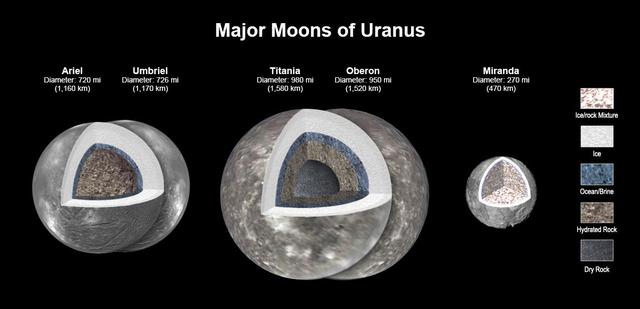
NASA's Planetary Science Decadal Survey identified a flagship mission to Uranus—the proposed Uranus Orbiter and Probe (UOP)—as the highest-priority new planetary mission for the 2030s. A dedicated orbiter and atmospheric descent probe will unlock key questions regarding ice giant interior chemistry, ring system dynamics, and potential subsurface oceans on moons like Miranda, Ariel, and Titania.
You can inspect Uranus' extreme axial tilt (98 degrees) directly in our interactive 3D Solar System Explorer.